Showing posts with label master document. Show all posts

Saturday, November 21, 2020

Update 2020-11-21 on MEST 2.x

 It has been a crazy year. Shelter-in-place. Crazy Presidential Election. And other new and strange
things not worth mentioning here.

These are further notes as of 2020-11-20 regarding the draft file at https://drive.google.com/file/d/0Bw91639XP2nbemNLaE1Ib3N4b28/view?usp=sharing

OVERVIEW

MEST Tactics is a core rules book for battles across matter, energy, time, and space. It forms the basic foundation for multiple settings and genres ranging from Dark Fantasy, Gothic Horror, Victorian Sci-fi, Pulp Action, and Post-apocalyptic Survival.

A new Overview section near the start of the rules outlines the wars across the fabric of reality and introduces the idea of Thought Beings which use the players of the game as proxies for their many battles.

This serves a background for the use of character progression, Champions, Factions, and the Campaign system.

ARCHETYPES

Here are these Archetypes in concise format showing Build Point costs (BP), and their stat-lines for Close Combat Ability [CCA], Range Combat Ability [RCA] Reflexes [REF], Intelligence [INT], Willpower [POW], Strength [STR], Fortitude [FOR], Movement [MOV], and Size [SIZ].

Concise format show them in this triplet set;

CCA-RCA-REF | INT-POW-STR | FOR-MOV-SIZ

Common Archetypes
The are now 5 Common Archetypes which are types of unit profiles which are most frequently available and used within each game session. These are in order of capabilities; Untrained, Militia, Average, Veteran, and Elite. 

Untrained 012|211|223
Humanoid. 7 BP.

Militia 122|221|223
Humanoid. 20 BP.

Average 222|222|223
Humanoid. 30 BP.

Veteran 333|232|223
Humanoid. 61 BP.
Grit.

Elite 333|333|333
Humanoid. 129 BP.
Grit. Fight. Shoot.
  • Untrained represent civilians and other non-combatants. 
  • Militia represent conscripted fighters, green military, and poorly-trained combatants.
  • Average are the regular troops; the most commonly encountered combatant.
  • Veteran are the salty-dogs and experienced fighters. They've seen things.
  • Elite are the crack warriors, the best of the best. Highly proficient at skirmish warfare.

Specialist Archetypes

I've added new Specialist Archetypes; the Healer, and the Agent. 

Healer 012|232|223
Humanoid. 52 BP.
Heal. Medic. Grit.

Agent 132|232|223
Humanoid. 38 BP.
[Solitary]. Grit.

  • Healers receive the Healer X trait which provides +X Wild dice for the Revive action. Cascades can be spent to remove Fear, Burn, and Poison tokens as well as remove the normal Delay and Wound tokens.
  • Agents are terrible at Close Combat, but are better than Average at Range Combat and have higher FOR representing their increased survivability. 

TRAITS

There are 245 traits covering all periods, ages, settings, and genres. There are 38 Disabilities and 128 Abilities in total. These are now given one or more of the 14 keywords so that they can be used with the Character Progression system. Skills represent 60 of the traits, and there are 79 traits associated with Vehicles, Weapons, Armor, and Equipment. 

Here's an example of a new Trait which can be used with any character;

Arcane <Item> — Asset. Magic. Any Armor, Equipment, or Tool may be prefixed with this classifier as part of its name and will function as though the character has that item.

An Arcane Musket could be a regular Musket but it now can be something not sculpted on the model. Essentially it functions as the Conceal trait, but can be Dispelled. 

ROF [Rate-of-Fire] Attacks

The [Feed] and [Jam] traits are removed from the ROF X trait. This allows ROF X to be assigned to Weapons which are not machine pistols or rifles such as Rapid Fire Crossbow.

Situational Test Modifiers

Surprise has been renamed to Suddenness because there are some WIP rules for "Surprise" status now. 

Situational Awareness

This is an advanced rule that ensures that any player's Designated Leader needs to be able to see (have in Line-of-Sight or LOS) at least half the members of their Assembly. It is tweaked now to work better with the Radio X trait by creating a range limit to those members.

ACTIONS

A new feature is Consecutive for consecutive attempts against identical conditions. This is beneficial mostly for Fiddle actions though it could arise for use in combat situations.

Hide has been made more consistent in that all Hidden models may reposition up to MOV x 1" if any Opposing models moves within LOS. Before this was limited to being within Cohesion. Hidden models target by Indirect Range Attacks may always reposition but not lose their status.

Fear Tests

A character performs at most a single Fear Test per Turn. This helps with being targeted by Mythos creatures such as Deep Ones, and also from being subject to multiple Tests when attacked successfully by multiple Opposing models.

Bonus Actions

Cascades are now required to be spent to use a Bonus Action afte a Hit or Damage Test. The Push-back and the Pull-back Bonus actions benefit from spending two or more cascades when the Opposing model has a higher Physicality. Having zero cascades remaining afterwards disallows the Damage Test from being performed.

Passive Player Options

Whenever the Attacker fails the Combat Hit Test, the target character may perform a Bonus Action and acquire a Delay token. The character must of course be Ordered Attentive, in Wait status, or have higher REF.

REACT ACTIONS

Cleaned up lots of phrasing. A Ready Ordered Attentive character within Visibility and LOS of the Active model may also perform a React action without needing a Wait token.

ADVANCED GAME

This has many new additions and rephrasings.

SUPPRESSION

I think this is near-perfect now. Still needs a bit more play-testing. Models with ROF weapons may now choose to perform a Suppression Attack against a target location. If Attentive they'll receive an additional Suppression marker to place if one is already placed for the current Action.

FANTASTIC ITEMS

Several new keywords known as "Classifiers" are available to assign to Weapons, Armor, and Equipment to increase the flexibility of those items. These classifiers function similar to synonyms but have light-weight rules defining their benefits. The new classifiers are; Arcane, Energy, Etheric, MEMSic, and Psychic. With this, the standard Medium Shield could become an Arcane Shield, Energy Shield, Etheric Shield, MEMSic Shield, or even Psychic Shield.

LIGHTING

This has been a headache for a some time but I think it is now near-perfect. It is very granular as presented and so I'll need to create a Basic Game version. The Light X trait of a Flaming Torch (Light 4) or Basic Lantern (Light 6) creates Visibility OR equal to Light X, and provides +2, +4, and +6 for being Ordered Attentive, in Wait status, or in base-contact with it or when holding it. Models in LOS but further away provide a Visibility OR equal to the Light X but with a drop-off of 1-2-3-4-5 at distances greater than 1-2-3-4-6-8 MUs.

MAGIC SYSTEM

This is still big work-in-progress. Most of it is in note form which I need to transfer into the core rules document and make it look pretty. The skeleton of this is place within the document now.

INTERCONNECT GAMES

This a simplification of many hundreds of hours of notes and sub-rules. The key introduction is the Technological Periods and Ages are now defined. These Periods and Ages constrain which Weapons, Armors, and Equipment are available for any given setting.

Experience Points

Still a work-in-progress. It now ties into the Thought Beings concept and works primarily to create Champions though non-Champion characters can also benefit from this section.

Skills Acquisitions

Using the new keywords such as Skill and Psychology aides in identifying which Traits can be improved using Experience Points [ XP ]. A standard way of determining how much XP is necessary to increase the level of that Trait. Answer is usually several Missions. Attributes may also be improved with the application of XP.

Champions

Players control characters within Assemblies and resolve combat using Missions. Those characters can be promoted to Champions which are a sort of collection of bonuses representing a psychic spirit which inhabits physical hosts that are each character. 

Characters which are not Champions are not managed by the player and can change-out between sessions. 

Champions gain a Reputation X trait which behaves similar to Fear X but operates within LOS. The more powerful a Champion becomes the more likely it will want to flee the current reality and escape the control of the player.

Conclusion

There's a bunch of more things in the draft rules, and I'll continue to get them play-tested and cleaned-up. Until next time!


Friday, June 29, 2018

MEST v2.x :: Additional Archetypes


Overview

As always, I'm striving to make MEST v2 complete and correct.

Archetypes are basically standard collections of attributes and traits. Common Archetypes are normally what each game session of MEST starts with. The most most basic is the Average Common Archetype where all Attributes are just 2 (average human), and there are no traits assigned.

The most expensive is the Hero Common Archetype which has a whole bunch more. See the image here for the complete table;

The Common Archetypes representing most human or humanoid characters. These haven't changed very much from MEST 1.6x except for maybe their BP costs and some tweaking of traits, especially for the Acrobat. I think the Beasts (Dog, Fiend, Predator, Monster) have had some adjustments as well.

Variant Archetypes

To add variety to each game-session, I introduced Variant Archetypes. Again, these are presumably human or humanoid character types. Therefore I've introduced entries such as Average, Cultist, or Acrobat, Sneaky, and Mystic, Leader. I've created quite a few to cover most situations or settings, being that MEST is a per se "low-magic" or "realistic sci-fi" game system. 

Here's a sample of the provided Variant Archetypes;


Animal Archetypes

For some players with a wide collection of figurines and miniatures, I've added Animal Archetypes. The table is a bit large and in all likelihood incomplete, but it does include entries for Bear, Cave Bear, all sorts of Dogs including Wargs, all sorts of Horse, and even a Komodo Dragon. As I build out more of MEST 2.x I'll probably expand the table just wee bit more, but the idea is to not be complete in the baseline rules since I'll have the genre documents to do that for me.  For example, the Dunjon of Death genre document will include varieties of giant spiders, rodents of unusual size, and maybe a few slimes or molds.

Here's a quick look at the include animal species;

The various animal species available for MEST 2.x. I like the fact that I've got all sorts of dog species listed so that I can differentiate between Wargs, Wolves, and Hounds!

Sophont Archetypes

A Sophont is an intelligent species commonly encountered in science-fiction and fantasy settings. The default sophont for MEST is "human", and most humanoids in MEST are just like what you'd find on television or in movies; humans with make-up otherwise known as "rubber-forehead aliens".

Therefore it wouldn't be unusual to limit alien species in MEST gaming sessions to just the Variant Archetypes and have ALL Klingons be Veteran, Warriors or Brawler, Knife-fighters, with just a few also being Leader, Fighter or Brawler, Brawny.

However, I've decided to list a few common sophont species for quick use. Just like the Animal Archetypes table where this list of Sophont Archetypes is not meant to be complete because each of the genre documents will introduce setting-specific entries. For example, the Gothic Horror genre document will introduce Wampiri ("vampires"), Lycans ("werewolves"), and Ungasumati ("mummies"). 

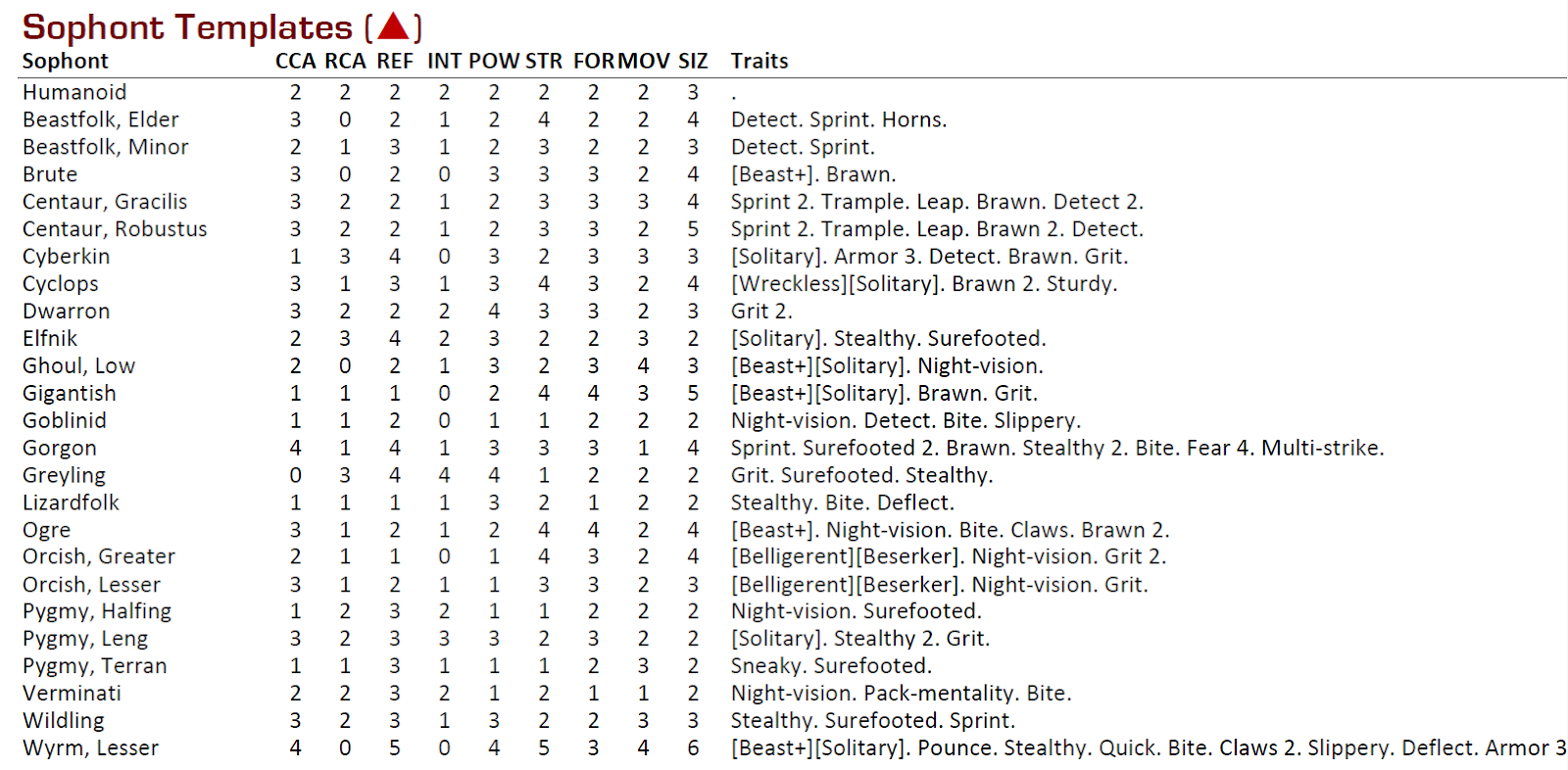
Here's a quick look at the included sophont species;

The current set of intelligent species included with MEST 2.x. Many of the names are specific to my FYBS role-playing game (I'll create a post later), but some of the entries shown are intuitive such as the Tcho-tcho being Pygmy, Leng or the Verminati being espys for GW's Skaven or Mantic's Verr-Myn.

Custom Archetypes

I wanted to provide a way for players to create their own Archetype, just in case the tables for Variants, Animals, and Sophonts is not enough!

The problem is that the points-costing system I use is very prone to abuse, as is any points-costing system. I've been tweaking and adjusting the system for several years now and I think I've got the numbers pretty much where I want them. 

Here's the gist of the system;
  • All characters have a BP cost which is a combination of all costs of their traits and attributes.
  • Some traits and some attributes are so powerful that they make the character exponentially more effective. Such considerations are REF, FOR, Tactics, and Leadership. 
  • For these traits and attributes, I introduce a Cost Ratio factor [CR]. These are written as +1 or -2.
  • Each CR represents a proportional cost adjustment. +1 CR means that for every 10 BP a character is worth, it increases in cost by +1 BP. So a 100 BP character with +1 CR is worth +10 BP extra; total is 110 BP. Also, a 100 BP character with a -2 CR is worth -2 BP per 10 thus -20 BP less; total is 80 BP.
  • You can think of CRs as fractional factors. Just divide by 10 and add 1.0. So +1 CR is x1.1 and -2 CR is x0.8. Same with +4 CR or -3 CR; these are x1.4 and x0.7 respectively.
You can see how having a spreadsheet or maybe having a very clear, concise process for determining costs will be useful.

Building a Custom Variant Archetype

So, one of the many ways of creating a Custom Archetype is to combine a species template from the Animal Archetype or the Sophont Archetype tables with an entry from the Variant Archetype table.

Let's combine the Brute Sophont with the Brawler Variant. Here's both templates next to each other; take note of the last two columns for dBP ("delta build-points") and CR ("cost ratio").

We'll combine these two templates.

Steps
  1. The first step is to add the dBP from both templates together. This makes +26 dBP plus +25 dBP for 51 dBP Total.
  2. The second step is to note the CRs and order them from highest to lowest. So, its +1 CR and then -2 CR.
  3. The third step is to adjust the dBP Total using the CRs in order. First is +1 CR. This means for each 10 dBP, adjust the cost by +1 BP. For 51 dBP this is +5 BP, causing a new total of 56 dBP. Second is the -2 CR. This means for each 10 dBP, adjust the cost by -2 BP. For 56 dBP this is -10 BP, causing a final cost of 46 BP.
Here's the above in picture form:

Math. How does it work?

For people with calculators, we can just convert the CRs into decimal factors by dividing each by 10 and then adding 1.0. So +1 CR becomes 0.1 plus 1.0 = 1.1. And -2 CR becomes -0.2 plus 1.0 = 0.8. Multiply both together 1.1 x 0.8 = 0.88. That factor is multiplied against the Total dBP of 51 making (51 x 0.88) = 45 BP.

The difference of 1 BP between the two methods is small enough to ignore during game-play because players are allowed to have upwards of 25 BP differences into totals for their Assemblies.

Anyhow, we'll call this combination of Brute + Brawler maybe "Brute Brawler". If we'd add Leap, Claws, Bite, and Detect, it could maybe become a Kzinti in "rage mode".

Other Custom Archetypes

I've included rules for creating other archetypes as well. I've got one for creating new Sophont species and another for creating new Animal species (or Sophonts, or whatever). 

Tables for generating new Sophont Archetypes.

Tables for generating entirely new Custom Archetypes. These can be used for crating new Animals and new Sophont species.


Traits Lists

Lastly, I've decided to make the most common Character Traits become available. This is sort of open-ended; I'd rather that any new archetypes don't use more than few beyond whichever was used for the creation of Variants, Sophonts, or Frames. Use at your own risk!

Here's the pick-and-choose list for traits. Go wacky and make things unbalanced if you'd like.

Finishing the Kzinti

Above we've created the Brute Brawler Archetype. It's 46 BP using +51 dBP and CR 0.88. Let's make it represent a Kzinti from Larry Niven's Kzin-Man Wars by adding Leap, Detect, Claws, and Bite. And for theme, we'll also add [Berserker]. 

We can get those traits and their values from the Character Traits List above.

Bite is +9 dBP
Claws is +3 dBP
Leap is +8 dBP
Detect is +5 dBP
[Berserker] is -2 dBP and -1 CR
Brute Brawler is +51 dBP

Total is 74 dBP.

Final Cost is 74 x 0.88 x 0.9 = 52 BP

And there you have it! 

The Kzinti Write-up 

Using the MEST v2.x recommended format, the Kzinti write-up looks like this:

Kzinti 402|044|424
Brute Brawler (+Bite, +Claws, +Leap, +Detect, +[Berserker])
[Beast+][Berserker]. Bite. Brawl. Brawn. Claws. Detect. Leap.
52 BP /+74 dBP -2 CR

The top series of numbers is CCA RCA REF | INT POW STR | FOR MOV SIZ in that order.


Tuesday, October 4, 2011

Supers

I've been busy creating a "Master Document" for the weapons and traits that I'll need for the MEST Narrative advanced rules.  It will also help with the generation of genre documents. One of the benefits is that this document helps me think of what could be possible within the MEST Narrative frame-work so that I can determine interesting powers and traits.

Part of the exercise with the master list of weapons and equipment is to get a sense of what is powerful and what is not.  With the knowledge I'll be able to properly scale the powers of super-hero characters like the Hulk, the Flash, or Captain America.  Of course, I've got my own genre variation of this known as SH2156 which you can see an inkling here: Silmarrimis.  I can't wait to bring in Frenzy, Controller, Ogar, The Black, Futility, and a whole host of other unique creations.

I'm still in process of completing the more outlandish weapons for the document but already I can see that I'll have to consider the following for any super-heroes.
  • Fear.  These guys will have some equivalent of Grit 2 [ typical hero ] to Grit 5 [ Captain America ].  These are big numbers when combined with QA that goes from 3 to 6 for Dr. Doom or Mr. Fantastic.
  • Celerity.  I've created Celerity as a trait to allow characters like the Flash, Quicksilver, or even Spiderman to have more action points.  The thinking is still pretty rough, but I'll make the cost be a multiplier on the total BP worth of a character.  Spiderman would have 3 AP. Quicksilver probably 4 AP and the Flash 5 AP.  Movement rules will need to be identified as well.
  • Armor. Luke Cage and Rhino might have Armor 8+ which can stop a .50-calibre round.  The Hulk gets more armor as he gets angrier; probably start at 10 and +2 per 'Angry' step; it should eventually lead to being Berzerk.
  • Energy.  A character like Iron Man would have the Energize X feature for his armor.  Maybe it starts at AR 8 and goes higher - maybe up to 16.  But then his repulsor cannons may do 6 Damage and as high as 12 ... barely enough to deal with an Angry Hulk.  I'm not sure if I want to introduce energy management here; I'm sure there's an easier way to deal with overloaded usage by Iron Man.
  • Fight.  The majority of the supers from DC and Marvel have tremendous experience in fighting.  Batman/Catman/Huntress, Wolverine, Master of Kung-fu, Daredevil, Elecktra would have these probably at Fight 4 to 6.
  • Shoot.  Characters like the Green Arrow and Hawkeye would have Archer/Shoot 5 or 6.
  • Acrobatics.  Harleyquinn, Spiderman, Angleman would have these around 3 or 4.  Combine that with SPD 5 or greater and these guys become very hard to hit.
  • Magic.  Dr. Strange, Zatanna, and their kind are also very powerful.  I'm sure that there's a general way to bring in magic effects into combat that could make it interesting without being a game breaker.  There's already the HPL Mythos genre (work-in-progress) that is exploring use of the Spell Tables/Cards.  Maybe something like that.
  • Planning.  Many of the brainier heroes like Batman, Mr. Terrific, Dr. Doom, or Mr. Fantastic need to have a way to get the upper hand on the tactical and leadership situation by providing more than just assigning the Obviate, Tactics, or Leadership traits.  At some point those stats will bring in huge differentials in Initiative checks but won't do much for theme.  I'm considering a new trait that will allow mid-game changes .. sort of like a deux ex machina effect.
Anyhow, these are the extremes but should be because of the fact that the supers are the archetypes for those tricks.

To view the work-in-progress for the master document, visit  http://sites.google.com/site/mesttactics/ or just download the document directly from here.