Sunday, September 24, 2017

My Superhero 2044 Campaign

This might be too much information!

Overview

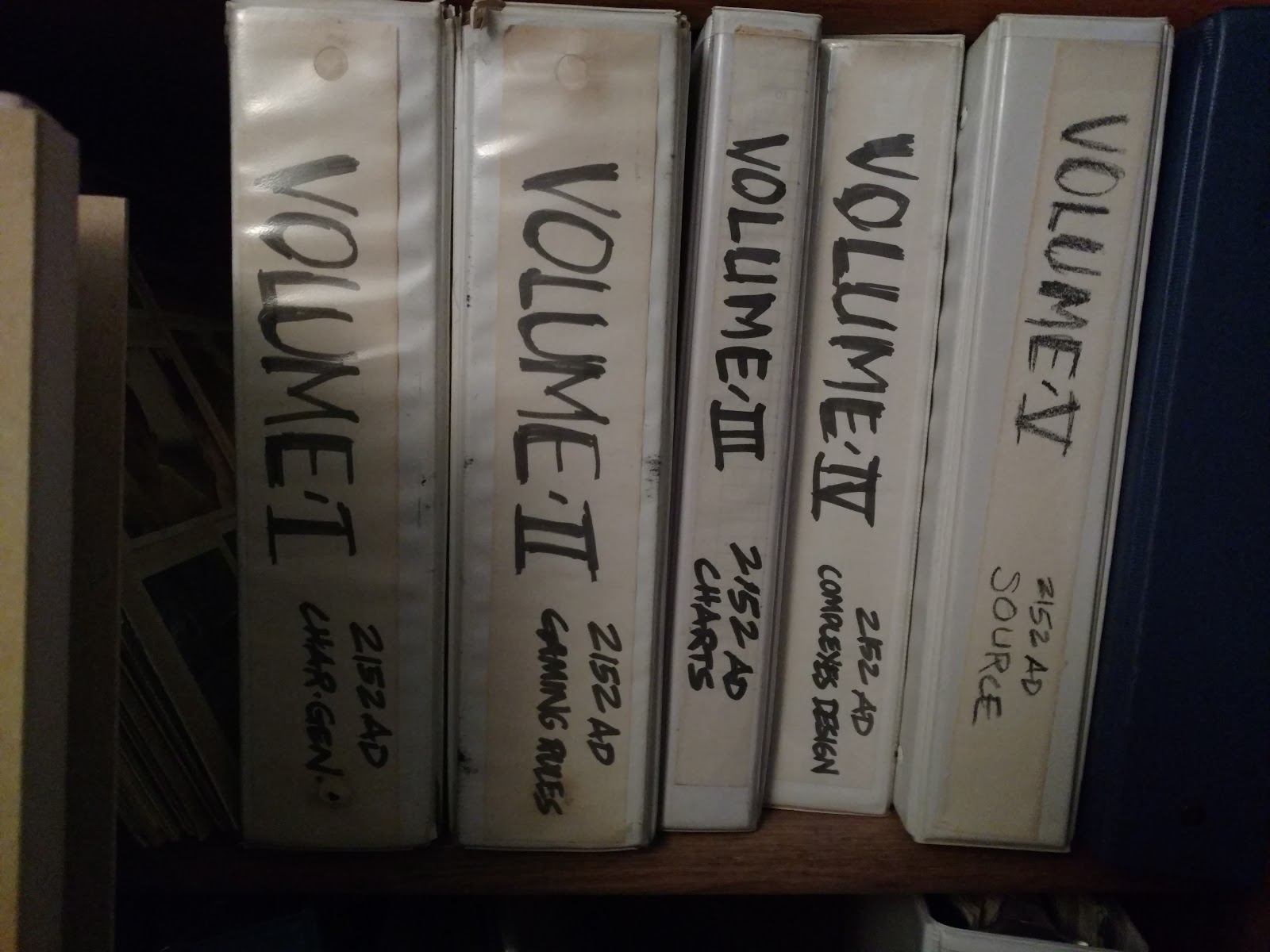
All 5 volumes capturing a significant part of my childhood and formative years as a role-playing game designer in the genre of  superheroes.
My Superhero 2044 campaign lasted about 10 years, maybe a little bit longer; I'm not sure. There was a gap of 3 or so years between my high-school days and my time in the USMC. I may have played a bit during the time on base. I looked through my notes and it seems that I created a revised role-playing game system that I named FYBS (F** You Bob System). With that I perhaps played another 3 years?

Anyhow, I decided to start connecting the pieces together again with the origins of the MEST Tactics skirmish wargame in its roots with my Superhero 2044 campaign. My opinion of that original game can be found on an earlier post here.  Essentially the game evolved as I (the Referee) played across a decade I was able with the help of my friends who where the players.

Through that time the characters acquired more power and began to become involved with politics and world-building. The original Superhero 2044 rules really didn't allow for such things and so I started pulling in concepts from other places; GDW Traveller, Time-line Limited's The Morrow Project, Hero Games Champions, SJG GURPs, SPI Starsoldier, and then also a variety of science-fiction and fantasy novels including Michael Moorcock's The Eternal Champion and Philip Jose Farmer's World of Tiers Series. I think those last two were students of Joseph Campbells The Hero With a Thousand Faces, which certainly influenced me as well. There may actually be several dozen more sources of inspiration which came to me after high-school; one of the later ones is Stephen R. Donaldson's The White Gold Wielder and the Chronicles of Thomas Covenant.

What follows below are photos of my collection of writings associated with that campaign. I'm hoping that by providing this information it will help substantiate some of my decision making for world-building and rules-building.

The Five Volumes

There are five compendiums of information.
  • Volume I - Character Generation
  • Volume II - Gaming Rules
  • Volume III - Charts
  • Volume IV - Complexes Design
  • Volume V - Source

Volume I - Character Generation

This is where is starts; each player in the game lovingly crafts a superhero or supervillain character. The contents of this section were my early attempts to make sense out of the potentials provided by Donald Saxman. I did my best based upon input from other games which I played. What evidence I show here is likely a post-influence set of writings.

This is the first volume. Lots of stuff to help keep character design consistent. It is house-rule after house-rule before I even knew that people did such things.

I started in 1977 at 13 years-old. My first serious attempt to capture everything and make it consistent is in 1978. I revisited this after my time in the USMC around 1988.
The campaign moved on, but the technology for drawing character sheets (at least for me) did not.


I was very much influenced by Alfred Bester's "The Star's My Destination" and the idea of jaunting not only across points in space but also across time.

A list of characters, and their origins, gene-bases, and McWhelan strata.

More characters. I think there's six pages.

The list of organizations in my campaign.

All characters are rated in "McWhelan Stratification Points" [MwPts] using my terminology as described on my other blog which deals with the Ovodium Cosmogos directly. Anyhow, an average character is about 400 MwPts to divide into its Prime Requisites (VIG, STA, END, MNT, CHA, EGO, DEX) and into its Skills, Powers, and Wealth. 

Because I was eventually influenced by Champions (this is when I was 13 and in 7th Grade for school), I tried to establish a methodology for consistently crafting Powers. As a result the rules became a bit ornate with how it would allow a power to be improved or limited using that system's weighted advantage system. This should look familiar: 

Actual Cost = (1 + advantages)/(1 + disadvatanges)

You can imagine the trickery involved with that sort of equation, and so the rules expanded (just like in the Hero System) to manage the edge cases which could arise. However, one thing I didn't like about Champions was that everything was effects based and there wasn't (at the time of the first edition rules) any standard more modeling physical effects like fire, radiation, etc. I chose to pursue that path (see Volume II - Gaming Rules).


Volume II - Gaming Rules

MwPts measure the relative importance the character is within the universe, at the given frame-parallel that is the reality in which the characters play. Other parallel universes (hence frame-parallels) could have the same character but at different MwPts rating. The Prime Frame would be where that character has already achieved its ultimate form, and those individuals are often corrupt with power.

This is the biggest volume in terms of written material. It is in places too technical and impractical to use in casual gaming.
Luck is a property of physics (in the game) which ensures that a character will always eventually settle at the strata in which it should rest unless it should have earned a new strata through the accumulation of Experience Points [XP]. In terms of the world-building mythology I set up, as soon as a character acquired Experience Points to increase its MwPts value it would shift its frame-of-reference and become the individual at the next immediate parallel dimension. Hence "frame-parallel". Here, I was influenced by the writings of physicist Roger Penrose who suggested that reality is a fractal crystal with all events being permutations along each length of the crystal. The human mind is similar to an electric charge and where it is in that set of permutations is the reality it is currently experiencing. Of course, I had to fold this into Hugh Everett's Many Worlds Interpretation in order to make sense of how a game could play out.

Therefore there is no time. There are just reference points in which the individual soul (my terminology) at any given position remembers things in "the past", and may remember things "in the future". So, the MwPts is like an index to the soul; as the index value changed the soul would pivot into another reality, another dimension, very subtly.

I created other sections in the Gaming Rules as well.

The political organizations within the Galadac Empire. The Galadacs present themselves as a mercantile society. In Barbarian Suns, mercantilism becomes one of the four meme-cultures which drive the forces at work to alter the destiny of the galaxy.

The New Orthodox Republic was what the Catholic Church eventually became as soon as they discovered the ease with which they could enter into interstellar society. They soon created three worlds; Heaven, Hell, and Purgatory. On our Earth, the remaining chapters of the NOR established the Guardian Angels Corps enforced by fanatic soldiers and gigantic Guardian space-fighter robots.

Types of NRG; "Neuro-Reimann Generators".

Luck as a balancing force in the universe.

Old School. I need to "correctly" identify how Vigor, Stamina, and Endurance were differentiated.

Since magic (symbolic energy) and emotion-control (via ECW or emotion-control waves) played a huge role in our gaming, I had to make sure that the Ego Prime Requisite was clearly defined.

The essential McWhelan Points definition.

An expansion of the implied privileges offered to vigilantes in the future. Each of these were licensed and as a result could be revoked.

The start of a very large, detailed, over-wrought section on magic. Magic is driven by manipulation of symbolic energy which is tied into emotion. It allows the creation of pocket-universes where the forces of the meta-universe can't cause a re-balancing of McWhelan strata. Often, misuse of magic will lead its practitioners to be stuck in those pocket-universes until the machinations of luck balance out.

More about magic.

Magic can be placed into devices using a complicated ritual involving chanting wherein the spellbinder imbues a configuration of symbolic energy into it and locks it into place. It involves emotion as well. I think maybe even some orgone.

I tried to list out my principal organizations and their goals.

More organizations.

More organizations. I probably had 30 or so, plus the original settings count; maybe 45 total?

My first illustration identify the MEST. Matter. Energy. Space. Time.

The arrangement of frame-parallels within the MEST.

A list of visited frame-parallels which are key harmonics. A key harmonic is a set of smaller parallel dimensions which are unique enough to be interesting to visit during game-play.  I think I used just 2 or 3 within my Superhero 2044 campaign. However, I built out each as a campaign setting for my FYBS design; one for each genre. I'll cover that at some later time!

With the destruction of Starbase One during the Martian Campaign, one of the last sets of matter-converters in the known galaxy was destroyed. These Clarke-scale matter-from-energy fabrication and defabrication devices where destroyed through-out galaxy through sabotage; both from religious fanatics (another meme-culture) and through espionage (another meme-culture). IIRC the Talimoran Guards were created to protect the the remaining matter-converters. Talimora is the origin star-system for the original designs.

Many of the alien species encountered (such as the orange-skinned Hjoyans) were very tall and so I established a new building standard for hallways, ceilings, and doors. This allowed, thematically, to ensure all Dungeons-and-Dragons style hallways and doors (5-foot wide corriders, 1.5-foot wide doors) couldn't possibly exists anymore in the setting. 

There also was a large section I created for identifying star systems. I created a graphical syntax for capturing my star system designs. With this syntax came my variation of GDW's Traveller star-system generation rules. 
I desperately wanted this to be different from what Marvel Comics, DC Comics, and other bodies of work proposed. In those writings their authors would acknowledge literary tropes which include fictional characters as being real in some portion of their corpus. Therefore Sherlock Holmes existed. And so did the god Ra or Hercules. And at the top tier of reality are abstract beings such as "Eternity" or "Chaos". And above them are the panel artists and script writers who are the paid staff of those comic-book franchises. Or, somehow; the universe is tremendously huge but it contains just 10 or so planets of strategic importance across 3 galaxies (Earth, Rann, Oa, etc). I thought those were ridiculous ideas (though interesting) limited in scope in terms of hard sci-fi. I didn't want either an Apokolips World nor an Valhalla. I wanted mind-bending scope, the same as I read in my favorite books. (The codex for that I eventually summarized in my Ovodium Cosmogos)

I wanted to try out the idea that the actual underlying reality is mathematically driven in some insane but predictable way. The Grand Unified Theory of Everything (GUTE) is realized within my campaign. Matter, Energy, Space, and Time (MEST) are inter-related at all lives. This requires new math. Make believe math, fake math, but new.

I created the concept of "Neurological Riemann Generators" [NRG, pronounced "energy"] which forms the basic of interaction within reality. Each character, a "pivoton", is an NRG emitter; able to pass magical energies through itself or because of itself.  Pivotons are codified by the types of energies which they project; N+ positive energy, N- negative energy.  At some point it becomes Pokemon with its use of discrete energy sources, but that was the reality of the new math.

Along the electro-magnetic spectrum (EMS, which now includes gravity and emotion), there is a correlation between energy effects and radiation frequency.  On the low-end, about 7-21 hertz is lightning and other electrical phenomena such as psionics with its field energies allowing telepathy and mental attacks. On the high-end for microwaves is the ability to generate radiation and cellular damage. On the very high-end is the realm of symbolic energy; cosmic radiation damages cellular structures but also alters reality. All of this is tied to emotional state. Information is a state the universe recognizes; it has mass and it can be altered by symbolic energy. So, that's where I put magic; it is the manipulation of symbols - the information keeping state organized.  Then of course, the middle spectrum of frequency dealt with heat generation, plasma, etc.

Volume III - Charts

Here's where I kept all of my notes. I had an IBM Selectric and also a Smith-Corona typewriter. I also had lots of white correction fluid to cover for my mistakes. I actually found it much easier to write stuff down instead of typing. As a result I accumulated lots of hand-written charts and tables.

A compendium of tables, charts, lists, and matrices.
What you'll see in the photos below are charts for everything! My armors, weapons, equipment, and vehicles charts were a little crazy. I think we used just 1/10 of the items, but I tried to be complete. For example, a player may want to get a plasma-gun. I would provide that and three other variations. I was wise enough, though, to make the entries generic. So; plasma-gun light, plasma-gun medium, plasma-gun heavy.

My first personality ("demeanor") selector!

One of many star maps. This one is for the Solani Sphere; that 100 light-year diameter sphere of control under stewardship by Earth through fiat established by the Galadac Empire.

A list of vehicles. This is one of the shorter lists.

Skeleton rules for exploiting natural resources on land or planets acquired.

List of metals, alloys, and super-alloys used within the game. There's some comic-book stuff, and there's entries invented by characters during the course of the game. Everything is based upon the idea that every +20 points in value is double armor strength.

There were many standard force-fields, force-shields, magic-shields, etc. Most of them have no visible-light spectrum representation and requires augmented-reality to see them. This is before the term "augmented reality" became a term; essentially it could't be seen without the help of computer-augmented vision.  The Negation Web is my favorite; looks like a dynamically shifting ball of electrical webbing.

I don't know why I have "Paint Gun" listed. I vaguely remembering that one of player's characters had to assign his war robots to repaint the exterior of his stealth ship to comply with some sort of regulation. I just think it was a joke; it was for that comical situation.

Really just fluff; a list of mercantile transport and travel lines for me to use during space-borne adventures.

My take on the grade of technology levels. I tried to be compliant with the Kardeshev Scale as well because TL 7 is Kardeshev 0.7. My scale ends here at 30-something to match with Type III civilizations.

List of tool-kits. The most popular one used is the CFAK or "Combat First Aid Kit" which is worn as an armband. Characters would normally have one, but one particular character wore it upon every limb and was a risk-taker.
A Galtec neuro-gun. One of the first emotion-control wave weapons introduced into the game.

Volume IV - Complexes Design

Eventually some of the players began to take over the campaign because they were more available with my gaming schedule. As their characters grew in power I began to build out rules for the acquisition of land, bases, battleships, and bases. This was a slow and painful growth in the game-rules and I looked into GDW's Striker and High Guard for influence. I crafted my own variation of that which I think was a little too much for me because I didn't realize at the time that the fun of these sub-systems for building vehicles is not in playing the game with the design but in building vehicles. It allowed too much tinkering, and too much specificity with hard-to-translate properties into a role-playing game.

Volume 4 spine.

Cover of Volume 4. Here you get a treat of one of my illustrations. There's more to follow.
Over time, I began to expand the campaign into a war in order to make use of the rules which I had established. This would be a variation of High Guard and allow me to send hundreds and thousands of warships into battle. Leading up to this culminating event, I crafted a background which allowed for the Earth to be a member the galaxy, which I named "The Avausim" or "Spirit of the Galaxy". The thinking was that there are huge intra-galactic cultures which have been at war for thousands upon thousands of years, going back to the time when our galaxy was cut-off from the remainder of the time-line in order to protect the universe from the inevitable; the ascension of human-kind and human-thought into god-hood. This eventually became expressed as my board-game "Barbarian Suns".

Influenced by High Guard.

The DcU scale is used for small-fleet actions. I designed two board-games at this scale which I'll cover at some later time. 

The standard hit-locations for space craft. These are tailored towards my vehicle design system.  For example, "MCavern" is a huge missile cavern which is a deep missile bay with tiers of missiles.

Some of the terminology used for the DcU game. The idea was to allow use of the carefully crafted space-faring battleships in a combat situation.

Anyhow, I created another board-game which would play using graph-paper called "In Defense of Our Mother"; the defense of Earth from conquest by the Huaggik Empire. Though in my original writings they are strongly influenced by the Gamilons from Star-blazer anime. The game scale was in 3 hours for each Turn, and the board was measured in 1-cm equal to 1 AU or astronomical unit; 150 million kilometers.


The invading hordes with their bio-organic ships and bio-organic stargates would bring in millions of horsecrab fighter ships and be repelled by the players's stellar alliance fleet. I had been prepping the war since the inception of the campaign ten-years earlier; some of the characters where already veterans of the Martian Campaign which involved expeditionary forces that repelled a Huaggik scout fleet with the help of the Galadac Empire, a mercantile society that seemed to know more than what it reveals. With that Martian Campaign, their outpost "Starbase One" was knocked out of position near our asteroid belt by the scout forces into Mars itself, killing millions as it crashed into Mons Olympus City.

The standard configuration for a planetary-defense system with distances between bases, orbital satellites, and other weapon systems near a planet.

The earliest map of the Milky Way Galaxy, or "Avausim" because what is shown are meme-cultures.

Naming conventions for ancient cultures within the Avausim.

Terms used to identify battlecraft.

More terms. I like SUDN for "Super Ultra-dreadnought" or "suddens!"

Definition of each class of battlecraft.

Some craziness. I used these power curves to build out my weapon profiles used in the game.

Some notes on how to calculate volume.

Tunnel Drive! A game-breaking technology used to get past enemy battle-planes. This was how the Talimoran system was attacked, leading to the destruction of Talimora and the strictly regulated matter-converters.

Black-hole Drive. A very dangerous technology which took tunnel drives in a complete different direction. Influenced by both Gatchaman and also Hawking Drives.

Holofield Generators covered the entire EMS including gravity and symbolic energy since in-universe the Grand Unified Theory of Everything has been codified.

I was a teenage computer programmer (two books co-authored by 17). Therefore I had to have something in place for computers in my rules.


Volume V - Source

In this binder I kept all of our illustrations and record-keeping papers which included all of the characters and vehicles. Some robots, and tons of notes. 

The final volume. 

Preface. This is a collection of characters and vehicles we designed for our game.
One of the first variations against the canonical Superhero 2044 Weekly Planning sheet. This one is for the Regulator; an armored scientist. I can't find his cartoon image in my archives ... too bad. I liked it. I must have given it away.

Black Nova. A thorn in many bad-guy's behinds. Well connected through his father David Horatio Hornblower.

Void. Power vampirism. Too much overkill.

Frenzy. ECW for berserker mentality. For himself and others.

Ogar. Renegade deranged Galadac Star Ranger recruited from Earth as a young child into Starbase One. He invented memetic regeneration which was imperfect and failed to correctly store-and-retrieve his mind between regenerations after catastrophic destruction of his armored form. Slowly went insane.

Siren. Surge projector for sonic attacks.

The Hornet. Joc Handoval. Deciphered the AI for a stolen matter-converter and began crafting genetically tailored space-hornets with a hive mind, all of which are under his control.
Part of the Hornet's character design log.

Naaru Ratonga. A Hyjoyan crime boss.
Naaru Ratonga's design log.
One interesting bit for people interested in Superhero 2044 specifically; the first edition (and second edition) rules made Inguria be a South Pacific island nation in a post-apocalyptic world where billions died after the Six Day War.  I initially had this as well, but I began to become influenced by the stories of Judge Dredd and how those Judges were more akin to the Science Police in the Ingurian setting.

Therefore I began to build out the rest of the world and established large mega-cities; none post-apocalyptic but all of them due to tremendously population growth multiplied by access to nano-technology and automated construction. There were 12 mega-cities, and Inguria was the 13th. Los Angles became a drowned region because of a tremendous earthquake which flooded San Joaquin Valley and parts of San Bernadino. The megacities were given project names such as Dojomaica for Sydney Australia, or Enoask for Hawaii. Enoask was the first megacity project and was given Enoask as a name from the Hjoyan peoples (orange-skinned giant alien people ... from outer-space) because it was the first one to use the combined science-and-engineering technologies for urban transformation.

Inguria. Megacity 13 (honorary). Apparently it is in the outskirts of Los Angeles, USA instead of the middle of the South Pacific. I probably moved it after the high-school.

Tokyo. Megacity 10.

Calcutta. Megacity 6.

Sydney. Megacity 4.

Sao Paolo. Megacity 2.

Hawaii. Megacity 1.


Now that I think of it, I also remember that there are several huge cybernetic tanks designed to look like MUTOs. One is named Alice and she is an artificial intelligence placed into the body of a Godzilla espy. Her current job is to go from mega-city to mega-city causing a wide swath of destruction in order to dramatically wreak havoc on old buildings and districts. She has a huge fan-base across the entire world and is remembered for those activities as well as her time in service as a warrior when piloting her Troll Unit during the Martian Campaign. The Troll units house these AIs and are meant to be troop transports. Mark II's are land-based carriers about 200 meters in length. Mark I are sea-based flyers which are also carriers but they are designed to lift the Mark II's into battle.


An example of a designed vehicle, the Necromancer. It is influenced by the move Alien. 


Interior of the Necromancer with hallways and state-rooms. Useful for role-playing.

Vehicle size chart. Each one of those has a design entry similar to the Necromancer.

One of the players was very influenced by Franz Joseph who illustrated the 1975 book "The Star Trek Technical Manual."


A Twerp Mobile. Designed by the Jester for use by his genetically engineered Twerps; explosive humanoids.


A Guardian space-fighter robot from the New Orthodox Republic, and a Troll Mark II. That little pimple at the bottom left is a human silhouette.


The standard Alakassi starbases, such as the one which had been quietly monitoring the Earth in 2036 outside of the orbit of Mars.

One of many Scientec designs used by the SciPol. These orbital fortresses hold geo-stationary orbits about Earth and Mars.

The base-line Scientec enforcement vehicle for LAWS; Land-Air-Water-Space.

Another Scientec design.


Hmm, there's still a lot in my head that is coming back to me. I will write these out in another post. I also have hundreds of pages of notes in probably a dozen MS-Word files that I'll need to digest again. Eventually it will make to the Internet, and hopefully in the form of its original intent; a background setting for a role-playing game. Hopefully one of my designs (revised) or for some other publisher.

The Photos

Here's the remainder of the illustrations. Lots of character illustrations as well.

The Big Bad Evil Guy. This BBEG was run by one of the players and was influential in driving the story to what it became. His origin is gaseous form, an intelligent crystalline cloud. The armor is just a means to interact with the environment.

Nubjan. Spell-binder.

Death Angel. Armored radio-active plasma-blaster.


Tai-tai. Tank and razor-girl.

Joker. Armored acrobat.

Dejavu. Minor ECW.


Controller. Teleporter and ECW.

Ninja. Teleporting acrobatic assassin.

Brythunia. Minor character.

Iron Woman? Armored blast projector.

The dissection of Damian Savage.

Cleric with cherub. New Orthodox Republic.

I'm not sure. I drew this in my biology class in high-school. 

Hell. A very angry supervillain.


Frenzy. ECW generator being hunted by the Guardian robots.


Riot Armor battle-suit.

Jester. A non-funny supervillain.

Crystal Knacht leader, Surge.

A New Orthodox Republic Guardian Angel. with holographic field projection for wings and mandala.

Cohort soldiers known as "angels" have their feet surgically removed so that they can fit into these "fabulous" battle-armors. They are the main-line warriors for the New Orthodox Republic.

A Twerp; a genetically engineered exploding humanoid.

Futility. ECW for giving up on life. Very effective.


Monday, September 4, 2017

Superhero '44 :: A retrospective

OVERVIEW

This is a review of the first edition of Superhero 2044 named "Superhero '44" self-published by Donald Saxman.

First Edition.

PUBLICATION

Superhero '44' was written by Donald Saxman [0], based on the ideas of a John Ford whom I think was his DM. The cover art and some interior artwork were rendered by Mike Cagle. It is the apparently the first role-playing game of this genre ever published.[1][2]

HISTORY

I don't have a copy the original rules anymore and I am cribbing notes using my memory and a PDF copy of the second-edition rules.

I purchased the first edition first printing black-and-white spiral-bound version of the Superhero '44 game rules from San Antonio Hobbies store in Mountain View, California in 1977 after visiting it with my cousin who lived in the area at the age of 13. I was intrigued by the artwork on the cover and the promise of a role-playing game set in the superhero genre. Nothing else similar to this existed at the time. I had only recently learned how to play Dungeons and Dragons white-box from attending an after-school gaming club in Milpitas through a classmate.

I had my own group of friends at school and we agreed to try this out. It was during my 7th grade and we wanted to bring the stories and characters from our comic-books to life. Over the course of two years my campaign game of interconnected characters and gaming sessions grew to accommodate about 10 players and perhaps 30 characters. Eventually, after playing the setting from 7th grade until 12th grade, I began to home-brew the rules to introduce concepts of later RPG designs such as Villains and Vigilantes and Champions.

When I returned from the USMC, I continued to expand upon the original setting to become my own and wound up with about 200 original characters, and an immense game universe which serves as the foundation of all of my game designs including MEST.

I stopped playing in the superhero genre and retired the home-brew after 10 years (7 + 3 year gap) of effort.

OLD-SCHOOL GAMING

Superhero '44 was old-school gaming. It had lots of ideas as a gaming kit, but very little in terms of a proper setting. However, there were some basic structures which I think were very nice and help ground my thinking. [3][4][12][13].

Constraints

  1. The game requires at least one player acting as the Referee, and at least one player with at least one superhero character.
  2. The game has no explicit rule against playing super-villains, but this would need to be house-ruled to make the concept fit within the setting and game structure.
  3. The game could be played solo using just the Activity Board aspect of the Patrol feature (see below) but it wouldn't be very exciting.

Quick Review

Rules Formatting - Terrible
Rules Organization - Terrible
Rules Clarity - Terrible
Art Quality - Terrible

Actually the artwork was good for Mike Cagle, bad for all others.  An overall B for the time; better than the original illustrations provided within TSR's white-box D&D or GDW Traveller.

Inguria at 1-KM per hex scale.
SETTING

Around the year 2044 the island of Inguria (Shanter Island) exists as the home of many prominent scientists and researchers, including numerous costumed heroes and villains. Presumably it is an island nation which is a part of a larger common wealth of islands within the South Pacific regions near Micronesia. When I played this game I never got a chance to purchase or review the expanded settings available via Judge's Guild's Hazard play-aide [5], and I never was able to peek into the second edition printing [6]. So no comment for those!

Some really cool ideas for technologies, culture, history, and locations introduced within the game setting:

Technologies

  1. Inguria is a small island nation which embraces green-energy. It receives solar power beamed from geostationary satellites, and a lava-powered convection wand power-station situated north of the island near its newly dormant volcano. It also has people movers which are these high-speed moving sidewalks (via Isaac Asimov).
  2. Science has advanced tremendously from the time of publication (1977) to the time of the setting (2044). In those 70 years there's been continued advances in micro-miniaturization and in genetics manipulation. Energy technologies have advanced enough to make laser weapons man-portable.
  3. Pseudo-dollars (PD) the precursor to today's crypto-currency which allowed secure exchanges of monies between any two entities. There wasn't the concept of Cloud Computing at the time of the writing and so these exchanges were using some sort of advanced electronics with transactions being kept in separate ledgers; at the personal level or at the bank. Both were susceptible to loss due to electronics failure.
  4. One of the really cool interior art pictures was the "Astrotank!" which was a flying tank with
    Astrotanks are Go!
    short swept wings. At the time of its writing very few Japanese animations were available in the USA, be it military or otherwise. I'm not even sure if the idea came from GDW's Traveller game. Regardless, it was a very small drawing but very exciting to me.
  5. The rules do include lists of weapons and general equipment. The weapons are rated according to damage, bonuses, or penalties they create for when using them or when attacked by them. The equipment list in both the first and second edition rules were just itemizations with costs; there were no paragraphs or rules associated with them.

    For example, an item available for purchase "Voice Stress Analyzer" for 1200 PD but what it means or what is does is up to the interpretation of the Referee and the players. Remember that this is back in 1977 AD; there was no Internet (post-DARPANet), no Google nor Bing search engine, If you wanted an answer you had to either already have an inkling, know somebody that does, or do some research at a library the old-fashioned way by checking out niche books and reading them.

Culture

An inspirational Sci-Pol image.
  1. The Science Police [7]; a force of law-and-order-and-science derived from DC Comic's Legion of Superheroes or maybe from Judge Dredd via 2000 AD comics.
  2. The game setting puts a strong focus on patrols, crime encounters, and prosecution by (hand-waved) law. This really grounds the genre into street-level supers. As a superhero fan, this sort of brings the character powers in-line with early 1960's Silver Age of comic-book superheroes [8].  Therefore power levels are somewhere between DC Comic's The Batman or Green Arrow, or Marvel Comic's Spider-man or Iron Man.
  3. Heroes are one of three origins; Ubermensch are top athletes who are trained assassins or fighters. Toolmasters which invent, combine, or engineer advanced technologies. And uniques which are allowed to be nearly anything else but likely have an origin in science or magic.

History

  1. Formians of Fomalhaut were an advanced-science extra-terrestrial species which brought new-fangled technologies with them after being rescued by the Inguria's former superheroes, now deceased. These lived in protective enclaves and worked with the Ingurian government.
  2. Several side-panel arts featured rumors about a Dr. Ruby whom was involved a crisis which destroyed Hendrix Island and killed (or made disappear) many of the original superheroes which protected the island nation as part of the Freedom League.
  3. Lastly, there is an android named Mr. Banta who runs a junk shop giving away bag-loads of old technology rummaged from those prior superheroes, and probably acquired from other places as well. Those black bags were a way to introduced interesting stories or technology or magicks to assist player characters over the course of their campaign.
NOTE: It appears after reading up on Thoul's Paradise that Donald Saxman declares Formians as a relatively low-tech planet.

Locations

  1. A map of Inguria is provided at the 1-hex is 1 kilometer scale. This was nice reinforcement of what was at the time (the 1970's) an introduction of the metric system.
  2. Smaller maps of Bloomberg and its down-town area were provided as well using a 500-meter and 250-meter scale.
  3. Several notable buildings and institutions and their purpose or relevance were identified such as the Koln Institute Alumni ("KIA") for training Ubermensch, or UniqueX for research and training of Uniques.
  4. About 3 dozen locations are labeled on the maps with choice names such as "Meady Swamp", or "Inguria Penitentiary" without much explanation as to their structure, policies, or use. This was fine by me as it allowed room for creativity.

STRUCTURE

Superhero '44 is structured to be played at two different scopes; at the tabletop via Handicapping Scenarios and during down-time using the Activity Board. This combination results in an interesting game-play structure and my cadre of players did it all for nearly 2 years across 20-30 weeks before moving forward with my home brew which dropped the Activity Board.

A copy of the original player sheet with the Activity board at the bottom.
Activity Board

All characters are presumed to be nascent heroes learning to climb the ladder to fame and fortune. It doesn't matter if they are Ubermensch, Toolmasters, or Uniques; they all must patrol the streets and districts of Inguria to fight crime, gather wealth, and pursue training or research.

This is done by requiring players to submit a worksheet in the form on planned activities for each game week. It is presumed that each real week of time correlates to one game week. From what I read, this feature is similar to what appeared within GDW's En Garde published in 1975 AD [9].
  1. The Activity Board shows an entire week in 6-hour Blocks starting on Monday and ending on Sunday. There are 4 Blocks (Morning, Afternoon, Evening, and Night) each day for 7 days. The first Block is 8 AM until 2 PM, then 2 PM until 8 PM, 8 PM until 2 AM, then 2 AM until 8 AM.
  2. Activities for each Block are to be described by the players for each of their characters. Sample activities are Patrol, School, Practice, Research, Rest, or Other. If two or more characters are to meet together for some event their player's are to write in that they'll meet at a given Block of time.
  3. Patrolling as an activity is covered below. The remainder activities are primarily used as character improvement Blocks. School, Practice, and Research all generate increments to long-term goals of getting 10, 20, or more Blocks of time to increase a acquire a skill, increase a skill, or invent/build/uncover a technology or clue. Rest is meant for recovery from injury of any form, and Other is whichever the player and Referee agree. Perhaps attend an inauguration or stakeout a specific criminal.
  4. Characters can be employed and have a job which generates a salary. These require 5 or more Blocks dedicated to that activity written presumably as Job for whichever employer was necessary. Taxes, food, insurance, and housing costs are all deductions from the income stream provided by the salary. Taxes are specifically 10% across the board and no tax evasion loopholes are provided.

Patrolling

The Referee is supposed to follow several steps for each character, figure out the "patrol results" for each character. As a young person with a home computer (Radio Shack TRS-80 Level II)[10] I was able to write a small script which helped me quickly figure out which players were where at what time. I needed this because at one point I had something like 10 players in the game as my campaign progressed. 
  1. A map of Inguria showing its named Patrol Areas is provided. Each Patrol Area has its own
    The various patrol areas on Inguria.
    Crime Frequency table entry which with a roll of a D100 generates a Crime Index value of 1-32.  For example; the Government Area consisting of the capital city of Bloomberg has a high incidence of #1 Assassinations and #25 Sabotage (8/100 chance each). But the Outback (near the northern jungles of the island) has mostly #18 Poaching as the principal crime encountered (44/100 chance).
  2. The number of possible crimes encountered is determined by the Crime Density Number which varies from 3 in the City to 0.25 in the Outback. This is multiplied by the number of Blocks with Patrol activity identified on the character's Activity Board. (Actually, it gets a bit more complicated than this, see below for Handicap Scores).
  3. All crimes encountered are resolved in the abstract. The criminals encountered might be stopped before the crime gets committed, but they might avoid capture. If they are captured, they might go to court and not be convicted. Regardless, these may provide leads to future situations which can be resolved as Handicapping scenarios.
  4. The Crime Data Sheet then provides success modifiers for different steps of the crime resolution process for Stop, Capture, Convict, Leads, Damage, and Injury. For example #1 Assassination has a -5 penalty for Stop (stopping the crime) but #18 Poaching is at 0 penalty. However, Assassination is at 0 penalty for Convict (convicting the criminal in court) while Poaching is at -3 penalty.
  5. For all crimes encountered, there is a chance of injury and a degree of reward in terms of pseudo-dollars. For example; Assassination crimes have a relatively low -1 penalty for Injury but a Reward dice of 10 representing 10-60 x 50 pseudo-dollars of reward monies. In contrast, crime #32 Soliciting has a high -4 penalty for Injury but a Reward of just 1. I guess pan-handlers could be dangerous in downtown Bloomberg. 
NOTE: I created a newsletter with those patrol results that had an overview section for the events in the campaign, entries for each character's notable encounters, and clues. I issued the edited patrol results back to each player and mimeographed [11] copy of a blank worksheet for the next week's journal. Players would pass around the newsletter during school hours. Some months I had too much homework, or got sick, or was lazy, and so the patrol results or newsletter would be delayed.

Handicapping Scenarios

In the event that a Patrol Result would lead to a character becoming grievously injured or dead, the Referee with the approval of the player which controls that character may set up a table-top gaming session to resolve it. This is known as a Handicapping Scenario. The Referee could also set up such opportunities for any other reason as well. The first edition rules had very little information as to what to do here, and so I relied upon my white-box D&D familiarity to generate those sessions, which I did at least once a month during school months and at least once a week during summer breaks.

The second edition rules provide more instructions as to what to include in those sessions such as how many bad guys, what kinds, and how they are armed. Furthermore, the second edition rules make known that "Deathtrap Scenarios" could be set up to drive character progression. Regardless, the basic purpose of the Handicapping Scenarios were to give an opportunity to increase a character's Handicap Scores (see below) which help when deciding the Patrol Results.

CHARACTER DESIGN

Character Types

A character must be one of the three types; Ubermensch, Toolmaster, or Unique.

Ubermensch can be KIA graduates, or have some other history. They must spend at least 1 Block each week Training. They also receive basic package skills in weapons proficiency and basic survival. Even with the second edition rules it is unclear how much each skill or proficiency is to be defined by the Referee or the player.

Toolmasters receive starting equipment, a break-through technology, and some area of expertise related to their powers. The archetype is Marvel comic's Iron Man or perhaps DC Comic's Green Lantern.

Uniques are allowed to have any power conceivable. Magic, psionics, or illusion, or anything else. The rules are completely open as to what those powers may be.

Prime Requisites

Characters are rated in several attributes ("Prime Requisites") using 140 Build Points (BP) assigned to Vigor, Stamina, Endurance, Mentality, Ego, Charisma, Dexterity. The minimum assigned value is 1 and the average is 20 with anything below 10 being penalized during game play.
  • Ubermensch receive +20 Vigor/Stamina/Endurance/Dexterity, and -20 Mentality
  • Toolmasters receive +20 Mentality, and -10 Vigor/Stamina/Endurance
  • Uniques receive +20 Charisma
NOTE: In my house-rules, I allowed for a fourth character type "Normal" which represents civilians; these don't receive a defining ability and were limited to Prime Requisites valued between 15 and 30.

Defining Ability

Lastly, players are to negotiate with the Referee for how to spend 50 BP for defining the character's powers, abilities, and other features. Those 50 BP could be spent on increasing the attributes further, or could be assigned in some other very specifically phrased aspect of the game as agreed with the Referee. I don't remember any character examples in the first-edition rules, but I see that in the second-edition rules are very loose examples for character writeups.

Appolyon has bonuses in "Master of Disguise and Computers", and Avenging Knight receives +100 Vigor and x20 Stamina (against 10 Stamina). Presumably Appolyon would receive benefits to his Handicap Scores (see below) or for Mentality when applied to investigating crime.

Maybe Avenging Knight receives those bonuses to its Prime Reqs but his armor needs to be worn, and might be at risk (during game-play) of not being available more than 50% of the time.

Handicap Scores

All characters are given 8 Handicap scores which are factored into the Patrolling aspect of the game to determine success. These are rated from 10 to 80 and can be increased during game-play after each set of Patrol Results. The first-edition rules weren't very clear on this, but the second edition rules provides for progression. Based upon a re-reading of the second edition rules I think those values should initially set between 2-4 and grow as high as 10 because they are used as multipliers.

Using the Appolyon write-up from above and spending some of its 50 BP; maybe "Master of Disguise" is a +3 to Capture and +2 Stopping and "Computers" is a +4 to Leads and +1 Conviction. I'm not sure what costs I ever assigned to these but a quick house-rule could make each +1 worth maybe 5 BP.

Here's how the Handicap Scores mapped to the modifiers of each criminal encounter identified for the Crime Data Sheet.
  • Stopping > Stop
  • Capture > Capture
  • Conviction > Convict
  • Leads > Leads
  • Damage > Damage
  • Injury > Injury

Location Effectiveness Number

There are two other Handicap Scores; Location and Prevention which work against each other for some reason. Location minus Prevention is used to determine the Location Effectiveness Number (LEF) which is a factor multiplied with a Patrol Area's Crime Density number.

For example, the Outback has a Crime Density of 0.25 while the City has a 3. This normally indicates 0.25 or 3 crimes encountered per Block of Patrol Activity spent. So, 4 Blocks of Patrol during a week will result in 1 encounter in the Outback or 12 encounters in the City.

However, if Location minus Prevention is -9, the LEF is 2/3. And if Location minus Prevention is -6 the LEF is 1/6. It is possible to have an LEF of 0 if Prevention exceeds Location by 7. The average LEF is normally 1/4. This makes the Outback have 0.25 encounters per 4 Blocks and the City have 3 encounters per 4 Blocks. I think I would have resolved that 0.25 encounters value as a chance of a single crime equal to 25% using a D100.

Character Growth

Patrol activities increases a character's Handicap Scores. Assigning Blocks upon an Activity Board for School, Training, and Practice will increase various attributes. Skills, powers, and other things are left mysterious. The rules specifically request that the Referee never identify how a character may improve such things to their players and leave it inspiration. I respect that and it fell in line with the old-school way of doing things.

Really; there were no concepts like Experience Points (XP) acquired for defeating Villain X at 1-to-2 odds. Completely free-form.

CONFLICT RESOLUTION

Prime Requisite Scores

Each of the Prime Reqs is used for a specific conflict resolution feature, and having a low score less than 20 or worse less than 10 brought significant penalties during Handicapping Scenarios.
  • Vigor; the health of the character and susceptibility to illness.
  • Stamina; the athletic ability of the character used for running, holding breath, dodging, and causing damage. 
  • Endurance; resistance to pain and fatigue. 
  • Mentality; the ability to solve puzzles, do research, learn new things, or outwit others.
  • Ego; self-preservation. Resistance to mental, magic, psionic, or psychological attacks.
  • Charisma; the ability to influence others using persuasion, charm, leadership, sexiness.
  • Dexterity; the ability to hit something. Reaction speed, balance, accuracy.

Turn Sequence

Each turn is 10 seconds long with 1-inch at scale equal to 2-meters. It seems that this was designed as a wargame using figurines a la Chainmail. I never used this feature prefering to role-play it out. However, the character with the highest Dexterity score goes first and having 30 or more in that score allows two or more actions.

No rules are provided for how far a character can move with 1 action or how to break ties. I sort of presumed distance of movement each action was equal to Stamina in meters; so 20 Stamina is 20-meters per 10-second Turn.

Kinds of Combat

There are 4 ways; Direct, Projectile, Mental, and Transformation. As an action, a character could perform one of those ways of combat, or of course do something else like help another character or unlock a door or drive a car.  Anyhow;
  1. Direct Physical Attack; hitting or striking with a weapon in hand or with using unarmed combat. 
  2. Projectile Attack; shooting a target at a distance. Or throwing a knife or rock at them. maybe shooting a fire-ball or lightning blast.
  3. Mental Attack; controlling the target's mind, terrorize them, or to create illusions. 
  4. Transformation; altering reality in some way such as making water to ice or changing a target into a chicken using magic. The attack might have limitations according to how the power or ability was defined such that the target must be in range, be visible, or be in touch.

Resolving Combat

Physical and Mental combat are resolved using 3 six-sided dice (3D6) added together and compared against a table to find a target number with the default being 11+. There are lists of modifiers which affect the roll of the dice as well as the attributes used for the combat.
  • Direct Physical Attack; compare Stamina of attacker and defender against the Universal Combat Matrix table to find the target number; the attacker must score that number or higher for success. Upon success, apply the weapon damage to the target. For example, a Sword causes a target to lose 20 Endurance and Vigor but a Fists (untrained) merely cause -5 Endurance.
  • Mental Attack; compare Ego of the attacker and defender against the Universal Combat Matrix. The defender receives bonus Ego for comparison depending on its awareness of the attack and its Mentality attribute.  Find the target number and have the attacker roll the 3D6. Upon success, damage is equal to the definition of the power used during character creation. Presumably there could be mental attacks which reduce attributes temporarily while the conditions of a successful attack (such as fear) are in place. This is never called out in the rules.
Projectile and Transformation attacks are resolved using a different mechanism where a single six-sided die is thrown, then its value modified, and the a second die is thrown to match or exceed that modified value.
  • Projectile Attack; a list of several modifiers are available such as range to the target, dexterity of the shooter, and whether the target has shielding, cover from terrain, or is wearing armor. Upon successfully hitting the target apply the weapon damage. For example, an assault rifle which hits the target with HE shot bullets will penalize it -30 Endurance and -40 Vigor. Whereas if the target were hit by a speargun is is penalized -20 Vigor and -20 Endurance.
  • Transformation Attack; very few modifiers appear here. Humans are +0 to that single first die roll. Formian targets cause +1 to the first score (a penalty), while inanimate objects cause -2 to the first score (it is easier to transform objects). Upon rolling the second die and matching or exceeding that first score, apply the effects of the transformation. So the rock becomes gemstone or the target human becomes a chicken. The degree and duration of the effect are completely negotiable during the design of the Transformation attack power; the rules provide no guidance here.
NOTE: My house-rules show that I altered Projectile and Transformation attacks to use the 3D6 as well.

Injury

The effects of injury as a result of reduce scores in one or more Prime Requisites is described in a couple of charts, but is not complete in effects or depth and breadth of description. I remember house-ruling most of this stuff. The setting allows that death from seemingly fatal injuries is uncommon due to the high technology available, but the characters must be admitted to a hospital or similar facility.
  • Vigor; having 10 or less makes the character incapacitated, wile 4 or less makes the character unable to move and is barely conscious. Unsure what 0 or less does ... death?
  • Stamina; there is no chart for this. I treated it similar to Vigor in regards to penalties.
  • Endurance; having 14 or less is being stunned and disallows attacks and limits the character to a single move action per 10-second Turn. A character is unconscious at 4 or less, and comatose at 0 with brain damage upon reaching a negative number.
  • Mentality; apparently it is just fine to have a low mentality. Nothing is written for a Mentality of zero. 
  • Charisma; no penalties for low or zero Charisma.
  • Ego; no penalties for low or zero Ego. 
  • Dexterity; 5 or less penalizes the single action any character is allowed. 
NOTE: I can see that the second edition rules allow for hit-locations, but I don't remember if that was within the first-edition rules as well. Apparently each body part (head-body-arms-legs) has 50% of Vigor. If any part fell below 10, it becomes incapacitated. Head with 0 Vigor causes death.

PLAYABILITY

How does the game play? I think it did just fine for its time. The setting was able to inspire me to branch from the high-fantasy world of Dungeons and Dragons. The Patrol rules helped provide for a structured down-time for characters and allowed long-term planning. The rules were certainly sparse and spotty in their implementation, but to a creative person they would encourage modification via house rules ... which is what I did. Lots of it.

Would I recommend this game in its original format to anybody today? No; there's just too much missing or let unclear.

SUMMARY

When compared to modern tabletop role-playing games it truly lacks. Many of the other role-playing games published during these early years except for perhaps GDW Traveller (also published in 1977) also lacked polish. It seems now that the rules as written were probably notes quickly captured by the author from some campaign he ran, but having likely no other rule sets written in the modern pattern; everything just became jumbled or described incompletely.

----

Notes

[0] See Donald Saxman's home page at http://www.thesestrangeworlds.com/author.html
[1] Per https://en.wikipedia.org/wiki/Superhero:_2044 it was the first edition which was black-and-white and known as Superhero '44. It did not have a color cover until after Gamescience games published the second edition as Superhero 2044.
[2] Per http://www.legrog.org/jeux/superhero-2044/superhero-2044-en it was published in January.
[3] See also this review at https://rpggeek.com/thread/1072933/superhero-2044-breakdown
[4] See also this review at http://robertdushay.home.mindspring.com/Museum/Superheroes/S2044revw.html
[5] See archive for Hazard play aide at http://www.museumofplay.org/online-collections/3/68/110.3016
[6] See Superhero 2044 2nd printing at https://www.scribd.com/document/324403481/Gamescience-Superhero-2044-Corebook
[7] See Wikia at http://dc.wikia.com/wiki/Science_Police
[8] See https://en.wikipedia.org/wiki/Silver_Age_of_Comic_Books
[9] See En Garde at Scribd https://www.scribd.com/doc/292247379/GDW-En-Garde
[10] See entry at https://en.wikipedia.org/wiki/TRS-80
[11] See entry at https://en.wikipedia.org/wiki/Mimeograph
[12] See entry at http://www.advanceddungeonsandparenting.com/2014/06/a-history-of-superhero-rpgs-game-by.html
[13] See entry at http://thoulsparadise.blogspot.com/2013/06/

Wednesday, August 9, 2017

World-building :: Realistic naming technique

Overview

I've been helping my dad on-and-off for about 20 or 30 years for writing his pulp sci-fi novel. I recently wrote up an simple tutorial for creating make-believe names for within a constructed language.

Roman Morphemes

See the link here for Greek and Latin morphemes which are root words ("morphemes") of the Roman language. What you should do is read the list several times to become familiar with the various root words and their meanings. We will use this knowledge to create a new language. Let's call this language "Romorphani".

Step 1 - Pick Root Words

Pick a few choice root words which give a hint to the intent you want. You could do this at random such as follows:

Page 1 we see act, acu, acr, ac, and alt.
Page 5 we see plic, plur, plus, pneu, polis, and polit

Step 2 - Smash the Root Words Together

Next, combine those root words together to create a new base term.
Combinations we could make just with the above; actplic, acuplur, acrplus, acpneu, altpolis

Step 3 - Insert some vowels

Some of the combinations will be weird. We can see that we'll need some vowels.  I'll insert them. Therefore add vowels between them if they'll need some, or remove vowels if they overlap. I just insert the vowels that make the final form look interesting like -a- or -i-.

actplic > actiplic
acuplur > acuplur (no change)
acrplus > acraplus
acpneu > acupneu
altpolis  > altipolis


So the list becomes:

actiplic
acuplur
acraplus
acupneu
altipolis

Step 4 - Evolve the Sounds

All languages have phonetic drift. The average rate is one shift of phonetic form every 800 years. Depending on influences from other cultures (conquest, trade) the shifts may occur much faster like perhaps 1 every 10 years for a short period of time. We are going to invent some rules to show you what I mean by "phonetic drift".

Let's presume that in your revised language, all first letter -i- after -a- become letter -e- and all -pl- becomes -th-. Lastly, any -the- automatically becomes -thy- because I think it's cool. That's three shifts. This would cause the name transformation as follows:

First make -i- become -e-: actiplic →  acteplec
Next make -pl- become -th- : acteplec → actethec
Lastly make -the- become -thy-: actethec → actethyc 


As you can imagine, this is hard work if you have a lot of names.

Step 5 - Add A suffix

Lastly, add a suffix of your choice to identify a person, place, or thing.  I'll will make some presumptions about the sorts of suffixes that we should use in this example as follows:

-ius, -us, and -os are male suffixes
-ia, -ya, -ina, and -iya are female suffixes


Here are my words using various suffixes appended to the word actethyc:

actethycius
actethycus
actethycos
actethycia
actethycya
actethycina
actethyciya


In all the above cases, the original root terms are acti and plic which mean (from the PDF) "to act" and "to fold". Perhaps then the character whose name is Actethycius is one who always folds his hands whenever tasked to work on something he hates.

To do things automatically, see the SCA information at the very bottom of this page.
.
.
.

Conversion of Existing Stuff

Consider these Roman terms which we can convert:


Magnifico
Scippio
Vangales
Augustus
Nerva
Agrippa
Zada
Khyber


Each of those have suffixes. We'll strip them:

Magnifico →  Magnif
Scippio →  Scip
Vangales →  Vangal
Augustus →  August
Nerva →  Nerv
Agrippa →  Agrip
Zada →  Zad
Khyber → Khyb


Now we'll do some phonetic shifts; let's do three new ones.  We'll make some of the -g- become -gh- and all first -a- not leading a word become -u-. Afterwards, all -i- becomes -a-.

Magnif  → Mughnaf
Scip →  Scap
Vangal → Vunghal
August → August (no change)
Nerva → Nervu
Agrip → Agrip (no change)
Zada → Zud
Khyb → Khyb (no change)

And now we'll add some suffixes. I'll make boys end in -us and -is and girls end in -ia and -a. Things that are not people have no suffix. Here's the revised naming:

Mughnaf  →  Mughnafus, Mughnafis, Mughnafia, Mughnafa
Scip → Scipus, Scipis, Scipia, Scipa
Vanghal → Vanghalus, Vanghalis, Vanghalia, Vanghala
August → Augustus, Augustis, Augustia, Augusta
Nervu → Nervus, Nervuis, Nervuia, Nervua
Agrip → Agripus, Agripis, Agripia, Agripa
Zud → Zudus, Zudis, Zudia, Zuda
Khyb → Khybus, Khybis, Khybia, Khyba


Of course, I have no clear knowledge of what each root word in the original names mean except by use of Wikipedia.

The Sound Change Applier [ SCA ] - Automatically Evolve the Names

Mark Rosenfelder has provided his on-line tool the "Sound Change Applier" [ SCA ]. This tool helps people create automatic changes to lists of names.

The tool is preset with a set of "sound changes" which you can apply to anything you create. Do this;

  1. Copy the variations of the actiplic names from above at step 3.
  2. Visit the site at   http://www.zompist.com/sca2.html 
  3. Look for "Input Lexicon" and replace all of that text with the content copied into the clip-board.
  4. Click the "Apply" button and look at the "Output Lexicon" field.
  5. You should see the following transformations:
actiplic → actiplic (no change)
acuplur → aguplur  (no change)  
acraplus → acraplo
acupneu → agupneo
altipolis → altiboli 

If you look closely, many of the rules from the SCA were applied. These rules do things automatically applying the "Sound Changes" configurations such as making -plicus become -pligo or -plicos to -plicjo.

Afterwards, I'll add my suffixes. I'll target the last term "altiboli" from the bottom of that list above. In this particular variation, I'll only use -cha for girls, -zho for boys, and -jut for neutral.

altiboli →  altibolicha
altiboli →  altibolizho
altiboli →  altibolijut

And as before, we can know that the original root words are "alti" and "polis" for "high" and "citizen, city". Therefore we can reason that a girl named Altibolicha or a boy named Altibolizho are probably high-ranking citizens or they came from a city high upon the hills.

Read more about the SCA rules here: http://zompist.com/scahelp.html

Wednesday, August 2, 2017

Preparing for Mech, Beast, and Infantry - Part II

Mech, Beast, and Infantry

I've got the rules for Mech, Beast, and Infantry v0.39 [ MBI ] posted on the Delta Vector forums. I'll be updating it soon before posting here; I'll do this after another play-test to ensure the game flow is correct. In the meanwhile, enjoy some progress pictures!

The Pictures

Here's my suite of assets I've assembled for MBI. The figures are based on 30MM fender washers. I'll need to primer them and then do enough for table-top quality. The models are from MechWarrior Clix and from Dropzone Commander. I've got four from the Robo-tech game as well.

I think I have 30 buildings. Some require their top walls to be decorated. All of them are from Hawk Games.

These are the objective markers. They'll count as terrain as well.

My mechs. The four in the back are from Robotech. The remainder are from Mechwarrior Clix.

Overview of my collection. The snake monsters are the size of a medium mech. I think they're from Mageknight Clix or something.

Tuesday, June 13, 2017

MEST 1.61 Basic Rules available

I corrected a number of gaps which I inadvertently introduced in version 1.60 back in the year 2015! The corrected version is dated 2017.06.13

EDIT: 20171224 - Apparently I left out the Victory Conditions section, and so this is added to the page 12 now at the bottom of the Quick Reference Sheet.

Overview

Most of the changes are within the full-color rules.

  1. Initiative rules altered; who wins, and how many IP tokens are awarded and to whom
  2. Added Common Effects and explained how to read, create, and use armor and weapon effects.
  3. Added traits for Night-vision, Insane, Slippery, Trample, and Thrower.
  4. Added 16 pages of Assembly information under sample genres.
  5. Also updated Table of Contents.

Effects

With the new section for the sample genres I introduce "Effects" which are ways of renaming armor and weapons.  So an Average character with Sword could be renamed as "Wolverine" with "Synthetic Claws". This already existed as a concept but I made it more formal by declaring it within the sample genres section.

Additionally, I listed "Common Effects" which are combinations of useful traits that can be assigned to weapons, armor, or to characters directly. For example, the effect "Tactical Genius" can now be assigned to Acrobats or Brawlers to provide those characters +1 INT and +1 Tactics. Or, the effect "Swift" could be assigned to ... perhaps some character as "Magical Boots" and provide it +1 MOV and +1 REF.


Advanced Rules

I realize that the rules for Magic and Suppression, two rules I have been using for MEST, are not included in the Basic Game rules which I think is the correct choice. I also realize that the points-costing system I have the MEST 2.0 (Basic + Advanced Rules) is dramatically different than what is available for MEST 1.61; this is something that will need to happen because some traits are just too powerful. Until that set gets released, I hope everything else is acceptable for play.

Download

see here https://sites.google.com/site/mesttactics/downloads and also at the menu at the right for direct links.

Sunday, June 4, 2017

Preparing for Mech, Beast, and Infantry - Part 1

Mech, Beast, and Infantry

see Part II here.

I'm building out Mech, Beast, and Infantry as a pre-game to Absolution War. It is in late-alpha early-beta and I'm setting it up on Delta Vector forums right now. Both games are 10MM (1:160) scale rules systems. I will need at least two in order to support Mech, Beast, and Infantry. I'll need at least two more to make Absolution War interesting.

The key feature of Mech, Beast, and Infantry is that there aren't that many unit types; the key three are walking battle-mech roboto stuff, infantry with their limited ordnance weapons, and huge cybernetic beasts. I'll probably bring in some drones, vehicles, and artillery later but probably also not. I want the setting to be very limited.

Any how, here's some of my early effort on building my armies. I've been purchasing Mechwarrior Clix figurines and converting them. Those are roughly 10MM. What I'm finding difficulty in locating are light infantry ... most of the models I find are power armor or heavy infantry.


The Infantry. I'm WIP with adding fine-grained sand to their new bases. I'll then cover it with Elmer's glue. These are Mechwarrior Clix units. I've taken some of the original clix and clipped them into two or even three new units after rebasing them. These are 30MM bases except for the solos which are on 25MM bases.

Some of the Beasts. In the background you can also see my Objective markers. I can use these for MEST as well.

Nearly everything here is prepped with the Elmer's glue at the top layer. I'll just need to spray them with black primer paint and then color them. More later ...

This is all that I have at present.I tried to group the units into Squads (using the MBI Formations nomenclature). There's something like 15 Squads here.  I ordered some more clix from eBay.  


Friday, May 12, 2017

Giant Robots of the Absolution War

UPDATE: Yeah. I've only recently recovered from nearly 9 months with a sinus infection and I'm so happy to have received some anti-biotics! The stress from my job didn't help either. My only solace is cups of coffee and maybe some white-noise.

Latest News

So, I've been getting more energy now that I've been feeling better and so I've been putting some effort into a couple of new designs. There's actually two designs; "Giant Robots of the Absolution War" [ GRoAW ] is the primary design and where these settings notes come from, and then there's "Mech, Beast, and Infantry" which uses a different design but is spiritually a sub-set of the first design.

What's been inspiring me is that I've got about 30 or 50 MechwarriorClix figures that are in the 1:160 or about 10MM scale that I wanted to use. I've been lurking in the forums for Dropzone Commander and thought that maybe I could do a MEST-flavored "improvement" over the basic concept; something within the Ovoidium Cosmogos universe, similar to my Web-published boardgame "Giant Robots of World War II."

These two new systems have been in development for about maybe three months; perhaps 20 hours a week. Still very rough, but my hope is that beyond the new genre and setting I can get a different take on how skirmish games could play out. Maybe some of this will help me improve the MEST 2.0 design that I've still got in the works.

I'll post up "Mech, Beast, and Infantry" once I wrap up the fundamentals; I'll probably post on Delta Vector forums first to get some (hopefully) positive feedback. It's currently v.0.25 and relatively short at 8 pages, and may grow to 12 pages when I'll be done. The main game GRoAW I'll probably keep improving in the backdrop; it may not see the light because I think it is more of a tinker's toolset akin GDW's Striker and GZG's Dirtside II.

.
.
.

Introduction

Giant Robots of the Absolution War (GRoAW) is a tabletop skirmish miniatures game played between two opposing forces with 1 or 2 players managing each force. The play area is a modern or futuristic city which serves as the battlefield where these forces compete for supremacy.

Each Player represents an aspiring Little Wars Commander at the War Event of 2588 AD. They have been selected to resolve an Argument (a scale of battle) as a literal Player voted to serve as the Face of a particular Diction which collectively are known as Stages of Conduct which can be any of the arcologies within the Solscept. The Players are responsible for selecting the best warriors, mechs, vat-grown beasts, and machinery, from a cadre of Practitioners of the Ritual of Absolution and the best Catalogs of Destruction. Failure or victory; either guarantees penitence in the Eyes of the Lord. But that is in the Spiritual Realm. Upon the material plane, upon this cursed Earth; the victor wins the adherents of the false philosophies to become initiates and converts into the One True Diction and eventually bring about the Correct Coherence of the Final Absolution.

Help fight the decisive battles of the Utmost Age within the Demesnes of Solscept! Prove your worthiness! Show your righteousness! Choose your holy weapons and machines of war, and demonstrate your tactical skills through proper maneuvering of those forces upon the battlefield. There may be death. There might be destruction. But indeed there will, by God; be redemption! Amen.

The Absolution War

The arrival of fusion power enabled the rapid access to the planets around Sol. Artificial General Intelligence, mini-macro-printing, and advanced robotics helped with the construction of vast arcologies here on Earth, at the Trojan Points, to the Moon, and beyond. Genetics assisted in populating the many worlds now known as Demesnes of the Solscept. Mastery of biomimetics transformed man and beast into malleable vessels for technology and increased each species' hardiness for survival in harsh environments. Virtual and augmented reality, the foundation of what is known as the Sensual Realms, allowed society to become entertained and informed. With the creation of the Cyberkhyber, a multi-planetary world-spanning network-distributed fortress with the Sensual Realms, death itself has been conquered and fear of it deters very few. No member of society has needs or wants within the actual reality of the Physical Realm.  It has been this way for nearly 300 years and nearly every biome, planet, and rock has become a fully-inhabited domain. The entirety of all settlements has flourished without conventional war nearly all these centuries. As a result, Reason and philosophy became the endeavors of the majority of all populations across all habitations, virtual or real.

Great societies arrived and flourished under the guidance of the Quiet Voice; that singular expression of all inter-connected artificials intelligences. All leaders speak factually, reasonably, succinctly, and emphatically their well-substantiated decisions. The people vote using similar informed reasoning. Many of the populations as a result turned from their studies within their virtual worlds to see the World as it is just to take note. Imdwellers, the peoples of the Demesnes, sometimes disconnect and wander outside their underground crypts to see their beautiful but nearly empty cities, transformed landscapes, and strange lab-grown animals managed and minded by robot caretakers of various forms. Some remain outside to live simpler lives and to guide the tremendous shaping processes brought by technology, and these became known as the Raucous Few.

However, the Raucous Few began to enjoy their freedoms of being Disconnected and began to shape the World by introducing Whispers of Dissent. These well-placed and well-disguised memes turned what had been seamless harmony within the Ocean of Words into mere stretches of Punctuated Equilibrium. Soon, the entirety of the Sensual Realm started to question their purposeless life and begun to seek meaning. Over time, the people and their leaders became belligerent. They had no vent except through their virtual games and this has become worrisome for many as those inclinations became Manifest as small chaotic exchanges of Death Without Reboot and unplanned property de-establishment. There must be more to life, the social network reasoned. Absolutely the style of living with all needs appeased dissatisfied too many. The resultant varieties of discourse within the Ocean of Words created a positive feedback loop especially among those Raucous Few.

Many of the Imdwellers turned to esoteric philosophies and others turned to specialization into religious studies for what better way is their to expend energy than to argue archaic writings? Competing ideologies raged across the universe of thoughts, each their own Diction in an Ocean of Words. A rare few persons, still numbering into the millions, specialize further into martial studies. These are the Practitioners who are enhanced with cybernetic dictionaries of kinesthetic verbs and forms, with codexes of warfare containing recipes for organized combat in all its forms. Flowery terms for each clade of thought abounded to mask the simplicity of these thoughts, these Dispensations.

The entire Solscept had been at peace for nearly three centuries, but the Dispensations became more limited and some transformed into binding Ordinances in order to curb extreme thoughts. The Raucous Few home these actions would limit virtual violence before it would escape towards the Physical World and affect even themselves. To Failure; no memes could stop their infectious ancestral idea; "To Be". Mankind has always had its braggarts, psychopaths, and visionaries. Each scheming or desirous of a better future shaped to their will whether it be wars of the body or spirit. In the ancient past these schemes were resolved with bloody aplomb upon far-ranging battlefields where upon thousands if not millions perished.

Soon, from the Quorum of Worlds formed by the Lead Voices of each arcology, a Resolution came into being. This Structure was designed to quell the stochastic outbreaks of violence which had become more frequent. It was made clear in these exact words issued to all of the Solscept; "Realm or Roe, Vec or Vulg; those who want to fight, fight. Those who want to stay, stay. We demonstrate our lessons and want them beg sway." This was 14 years ago, and it started what is now known as the Utmost Age; the age of warfare as a precise tool of argumentation. It has also become a channel for many who seek death but were too ashamed of their sensuous lives within the Ocean to merely end it at the hands of their semi-autonomous Minders.

Now is the Utmost Age when warfare is punctuated, refined, and focused into the Rituals fondly named "Little Wars". Only the participants, the Practitioners, are put at risk. Each school of thought or Diction has its voice here and the impact of a Ritual which has been decided affects the entire Ocean of Words. Hence now each nation has annual War Events comprised of Little Wars, in which they select among their best and brightest to demonstrate their righteousness through tragic plays of mayhem and madness.

Overview

I wanted to create something weird but familar. It needs be flexible enough concept, with some constraints, to allow players to bring their own ideas for units to the table.

Society

Many of the well-connected humans in society are utterly bored and live in virtual worlds.
  • Some of these have decided to fetishize their beliefs and become an adherent of an extreme philosophy known as a Diction.
  • The more arcane or religious the source of philosophy, the more adherents it will have.  Subjects range from Abrahamic religions, Scientology, Urantia, Wicca, New Ageism, UFO Conspiracy, Objectivism, or even Racism. 
  • These people join Memeleagues where the other members have a common Diction but multiple forms of Expression.
  • Some of these adherents have decided to change the world outside of their their virtual lives permanently. These are known as Practitioners.

Logos and Bios

  • It is possible for the mind to exist independent of a body. This is the Logos (loh-goss) and Bios (bee-oss) separation. 
  • It is also possible for a single mind to have copies of itself in different bodies. Each copy is registered as an Independent Member of a Logosbank and has rights just like any other human.
  • Bodies are actually transhuman; they've each been genetically and cybernetically augmented and are known as "Techno-organic". 
  • Most bodies, known as a Verum Corpus, are vat-printed on-demand without any memories to allow a Logos to control it.
  • Some Practitioners have decided to have pure-human bodies with few if any cybernetic enhancements, and just base-line genetic modification for diseases and general health. These are known as "Purists".
  • Most Practitioners switch out their bodies and when going to War can survive physical death through their Logos Devices which is stored within their skulls.
  • Many Practitioners desire to have a Single Voice, and will enter in a battle with duplicated Logos serving in different biological forms. This is known as Shouting the Din, and is considered to be somewhat like cheating especially when the Practitioner is supposed to be of higher standing. Each copy of the Logos makes the Practitioner become referred to as "The Unswayed" because of their stronger conviction during battles.
  • Some Practitioners, especially the wizened veterans of multiple wars, tend to become "Shut-ins". These have decided to destroy not to use a Logos Device when entering battle; death for them is permanent.
  • Some very few Shut-ins have been known to go one step further download their Logos into a stylized android construct to increase their durability. These "Machinamaksim" Practitioners are somewhat extreme even when compared to the others.

On-demand Constructs

The technology available to the Practitioners is astounding and can fabricate, grow, and customize any design crafted in the virtual world to make them physical within the real world. There are entire networks of artists, engineers, and researchers dedicated to crafting the best possible designs for use in these Arguments of War.
  • Retrodecofascii use designs from other eras including Gothic, Grimdark, Cosmic, Heavy Metal, Steampunk, Googie, Industrial, Atomik, etc.
  • Weeaboodo is pure art designs inspired by toys and cartoon characters. Many of these designs hail back as far as the early 1900 and 2000 AD.
  • Anachrocastrati employ sentimental designs of ancient eras of warfare such as Medieval, Pike & Shotte, Rifle Age, World War II, Vietnam War, Wars in Iraq and Afghanistan, and others. Nothing beyond 2100 AD

Design Goals

These were my targets for the design after several weeks of musing. Having little teevee time sort of helps here, as well as long commutes home from the office job.

Theming Goals

These goals are inspired by the Japanime stuff, even including something like Paprika. May old books as well, such as Heinlein's Starship Troopers and Keith Laumer's Bolo. I guess throw in some Metal Hurlant as well.
  • Strange Futurism
  • Heroic infantry
  • Style personalization

Mechanical Goals

These particular goals are a bit more like a wish-list. 
  • Faster game-play but more Rounds (pfft, shahright)
  • Fewer units
  • Allow models from any genre to be used
  • Make mechs, mecha, walking tanks significant
  • Make infantry survive unless against specialized weapons
  • Make aircraft stay on the battlefield
  • More tactics less luck (pfft, again because dice)
  • Flexible build-your-own
  • Integrated campaign system

Influences

Existing game designs and forums discussions always help influence me.